Reliable communications at sea have shifted from being a luxury to an operational requirement. Over the last few years, Starlink has changed how yacht owners, delivery skippers, and professional crews think about offshore connectivity — particularly on long South Pacific and Asia-to-New Zealand routes where traditional options were expensive, slow, or unreliable.
For yacht delivery operations, Starlink is not about streaming or social media. It is about weather data, routing decisions, operational coordination, and asset protection on multi-week passages.
Starlink, operated by SpaceX, uses a low-Earth-orbit satellite constellation to provide broadband internet with significantly lower latency than traditional geostationary marine systems.
For yachts, the practical difference is simple:
you can now maintain near-shore-quality connectivity hundreds or even thousands of miles offshore, provided the correct hardware and plan are in place.
From a delivery perspective, this fundamentally improves:
Weather model access and synoptic chart downloads
Real-time routing adjustments
Communication between shore support, owners, and crew
Incident response and decision-making
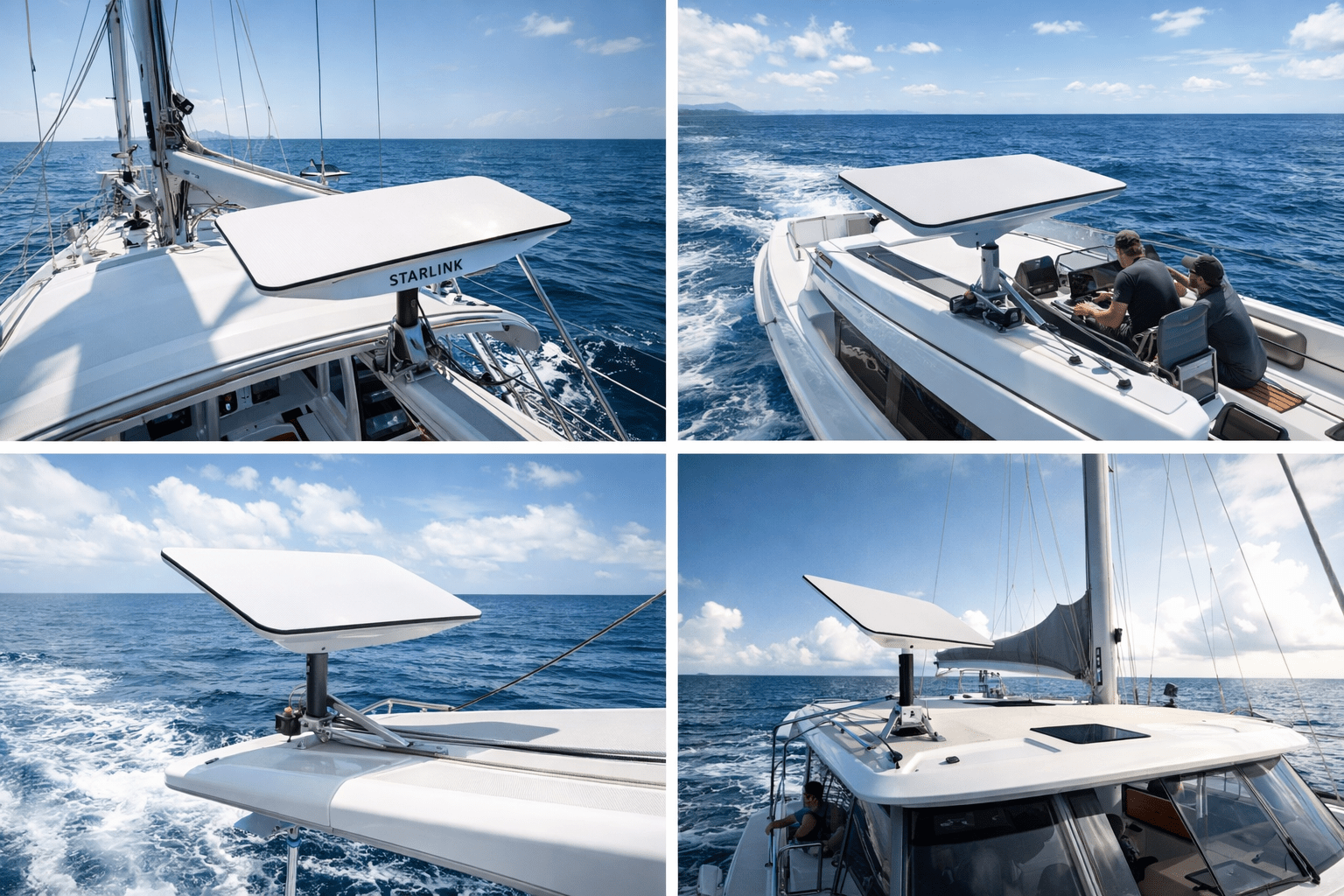
Most offshore yachts now use the Flat High Performance antenna. This unit is designed for mobile maritime use, handles vessel motion well, and supports higher throughput than the standard residential dish.
Installation considerations matter. The antenna needs a clear sky view, secure mounting, and careful cable routing. Power draw is higher than traditional satcom systems, so energy management — particularly on sailing yachts without constant generator use — must be factored in before departure.
For delivery crews, reliability and mounting integrity matter more than aesthetics. A poorly installed Starlink unit that drops out in heavy weather is worse than no system at all.
Starlink’s offerings evolve frequently, but for yachts the structure has settled into regional and global mobile plans rather than the old residential-only model.
At a practical level:
Regional plans suit coastal cruising and deliveries within defined areas (for example, Australia–New Zealand or Southeast Asia).
Global / Mobile Priority plans are required for continuous offshore use across ocean basins and multiple jurisdictions.
For professional yacht delivery, global coverage is the only sensible option. Anything else risks service interruption mid-passage, which undermines the whole purpose of installing the system.
One important operational point: Starlink enforces maritime usage rules based on plan type. Using a residential or incorrectly classified plan offshore can result in throttling or suspension at exactly the wrong time. Professional delivery planning treats Starlink as a regulated operational system, not a workaround.
In real-world use, Starlink coverage across:
Southeast Asia
Indonesia
Papua New Guinea
The South Pacific
New Zealand
is now generally strong when using the correct maritime-approved plan.
However, coverage quality still varies with latitude, satellite density, and local regulations. This is why Starlink should never be treated as a single-point solution. Professional deliveries still carry backup communications — but Starlink has become the primary data pipeline, not the backup.
Compared with legacy systems such as Inmarsat or Iridium data terminals, Starlink offers:
Dramatically higher data speeds
Lower latency
Better access to modern weather products
More practical use for routing software and forecasting tools
Traditional systems still retain value for distress and redundancy, but for day-to-day operational use, Starlink has become the dominant tool on professionally run yachts.
On long deliveries — for example Tahiti to New Zealand, Australia to Fiji, or Asia to Opua — Starlink changes how voyages are managed.
Instead of relying on delayed forecast updates, delivery crews can:
Continuously monitor developing systems
Adjust routing earlier rather than reacting late
Coordinate port entries and clearance logistics more efficiently
As we often say in delivery planning, we use advanced routing, weather analysis, and voyage optimisation to minimise unnecessary fuel burn, risk, and cost. Starlink enables that approach in real time rather than retrospectively.
Starlink is not a magic solution. It draws significant power, relies on clear sky view, and can degrade in extreme weather or heavy precipitation. It also remains subject to regulatory changes and plan enforcement that owners must stay on top of.
For these reasons, professional delivery crews treat Starlink as a critical operational system that must be configured correctly, monitored, and backed up — not as consumer tech bolted on at the last minute.
For yachts over 45 feet operating offshore, Starlink is rapidly becoming standard equipment. Not because it is fashionable, but because it materially improves safety, decision-making, and voyage efficiency.
The difference between a casual installation and a professionally planned Starlink setup is the same difference that exists throughout yacht delivery:
between improvisation and disciplined risk management.
 At Yacht Delivery Solutions, Starlink is integrated into how we manage long-range passages across Asia, the South Pacific, and New Zealand — as part of a broader approach to protecting high-value yachts on complex offshore routes.